Make your mark with patients

Published by permission of Dental Practice & Finance.
Make your mark with patients
By Mark Curtis
Among large businesses, logos play a crucial role in strengthening corporate identity and creating impressions in customers' minds. Take for example, Morton Salt-even as you read the words, you can picture the girl with the umbrella. Or when you think of Crystal Sugar, the bullseye may come immediately to mind.
Case 1
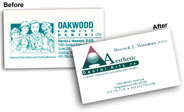 Before:
Dr. Veneman's previous logo took the concept of "family" dentistry to the limit. only the family dog is missing. While the illustration is informative in that it definitely refers to the entire family, it is not distinctive from other dentists' "family" logos. And, because the picture of the family is crowded and the business card is crowded, it is not inviting to read.
After:
Dr. Veneman's practice began to change as he pursued more advanced courses in combining bio-functionality, occlusion and esthetics in a comprehensive dental philosophy. His new logo combines three-dimensional thinking in a two-dimensional environment. Its tight design merges geometric structure with text. These characteristics show a multiplicity of disciplines a comprehensive practice style.
But, the concept has not been capitalized on as much in the world of small business, particularly among dental practices. However, even on a smaller scale, a well-designed logo and business card can help create or reinforce a practice's professional identity.
This is particularly important in a profession that often suffers an identity crisis. Unfortunately, a large segment of the public tends to believe all dentists are basically the same. Even among active patients in general practices, it's not uncommon to find those who could not name even one or two specific services their doctor provides, beyond the services they have had done themselves. Furthermore, many dentists are dismayed to find that patients who have been going to them for years will go to another dentist for esthetic treatment, mistakenly assuming their dentist doesn't provide the service.
As ill conceived as these notions may be to doctors, it's not hard to understand how these consumers develop their impressions. Their last dental experience may come from treatment received many years ago. Even established patients may not be aware of the range of services their dentist offers.
Case 2
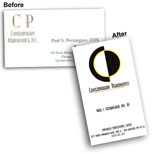 Before:
This logo was safe, reserved and understated. It might even be called "boring." if you've ever met Dr. Petrungaro or attended one of his seminars on implants, temporary implants, and hard and soft tissue regeneration, you will know that none of those adjectives remotely reflects his style.
After:
Dr. Petrungaro is bold, dynamic and opinionated. He draws definite boundaries between right and wrong, and he lives life to the fullest. This high-contrast logo helps referring doctors and seminar participants remember Dr. Petrungaro's energy and the positive impact of his convictions. The gold highlights soften the starkness of the black and white areas, and symbolizes the knowledge that emanates from the man.
One reason for this lack of awareness among dental consumers: They only know what they perceive and remember. Dentists who only provide generic information will find that their patients only have generic memories of the practice.
For example, the great majority of dental practices use the most Spartan of signs, typically emblazoned with only a single word: DENTIST. And even when a referral-willing patient recommends his or her dentist to a friend and passes along the doctor's business card, usually there is no memorable impression gleaned from the exchange. Often, the card contains only the doctor's name, address and phone number.
This begs the question of whether doctors are putting their best foot forward--or putting it into their mouth when it comes to how the public sees their practice.
I urge dentists to look at businesses in their community. A restaurant that specializes in Mexican cuisine would never have a sign that simply said, "Food " By the same token, an upscale women's clothing store would have the signage, marketing materials and "look" that would clue patrons in to the establishment's focus. Yet, why would a dentist who specializes in advanced elective dentistry settle for a generic "look"? As the examples in this story illustrate, a clearly focused business strategy, which is reflected in the practice's logo and business card-can enhance the practice's professional identity.
Case 3
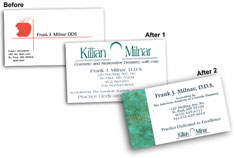 Before:
This was the epitome of "me too" dental logos. The apple symbol provided nothing to make Dr. Milnar memorable. The logo's red lines effectively broke the card into four areas and made it difficult for the viewer to perceive a flow to the information.
After:
Dr. Milnar had more challenges than just developing a new "look." He had committed himself to pursuing a more advanced level of elective dentistry in his practice. His practice partner, however, wanted to retain a practice strategy of traditional general dentistry for himself. Each agreed that a new practice logo was needed. In a few years, Dr. Milnar changed his practice strategy and sought to add some extra "punch" to his identity. Now, his personal logo reminds one of the practice logo, but speaks to a difference in Dr. Milnar's philosophies.
Should your practice design or redesign its logo? That depends on the type of practice strategy you employ. I believe there is no such thing as a "good" practice strategy or a "bad" practice strategy--only those that work and don't work. If your practice depends heavily on HMO or PPO patients, you are able to make a comfortable profit, and are successful at it, then this type of marketing issue may not be as important to you. Typically, the third-party payor will do much of your marketing by including you on its approved provider list.
However, if after carefully considering how you will position your practice you decide to go exclusively fee for service, with an emphasis on elective dentistry, it becomes increasingly important to create an image or personal identification for you and your practice. Likewise, if you want to stress that yours is a family practice, or that the dentist thinks "outside the box" when solving particular dental problems, you will want to stress these facts in your practice image.
As arguably the two most visible marketing cues, the logo and business card should work together to help your practice solidify or refine its identity. Ideally, these tools will be recognizable and memorable, reflecting the owner's current business strategy.
Before you decide to create a logo for your practice, you should be able to specifically state what you want it to do and know what a logo is capable of accomplishing.
Case 4
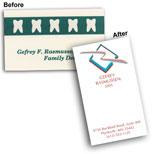 Before:
Dr. Rasmussen's logo was reminiscent of a wallpaper border-a border of teeth , The logo identified him as a dentist, but the styling and presentation did little to elevate the perception of his capabilities and technology.
After:
His current logo gives Dr. Rasmussen more of a feeling of artistry and forward thinking. The logo portrays movement and a willingness to extend "beyond the box." The slash also hints at the formation of an " R. " Moving his name and degree closer to the logo fulfilled the need to identify him as a dentist and more closely associated his name with the symbolism of the logo. This logo received a Gold Award from the publication, Graphic Design.
Targeting an evolving patient base
Many dentists assume that patients choose a specific practice solely by such factors as geographic convenience or the insurance plans the office accepts. In many instances these assumptions are correct, but often they do not tell the whole story of what influences patients' decisions.
The fact is, dental patients are more sophisticated today than in the past and are influenced by many stimuli. As consumers, they have become adept at interpreting subtle clues about practices and often rank them according to their visual impressions, the value of the practice's message and the degree to which a particular office matches their expectations and needs. They migrate toward practices that have philosophies, staff and other patients with whom they can identify.
Your business card and logo, along with your facility, brochures, ads and current patients, tell prospective newcomers whether they will "fit in."
Many doctors never realize it, but a practice logo and business card have an immediate as well as a residual effect on consumers. When patients see your business card, for example, they instantly make subjective evaluations of colors, type style, message content, creativity and sophistication.
The way these factors interplay with one another can speak volumes about you and your practice. For example, the interplay of graphics and text on a business card can reflect the clinician's ability to weave together a variety of disciplines, his or her ties to the community, personal style or commitment to a particular aspect of care.
Case 5
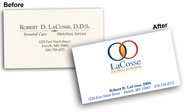 Before:
Although Dr. LaCosse's previous card had a good design, it had no character-no memorability. As such, it was caught between two practice strategies. it was straight and to the point, as it should be for an insurance-based practice. However, using two colors of ink added extra expense without taking the image of the practice to an elective, fee-for-service level.
After:
As Dr. LaCosse changed his practice strategy, he knew that he needed to change his image. This resultant logo shows the dentist and the patient working together as equals to achieve the patients' dental health and esthetic goals. The colors are bright and upbeat. The eye is drawn to the name and the practice statement.
Residual effects from seeing these marketing staples include helping patients to instantly recognize or remember your practice by more than just its name. Furthermore, your improved image may create "cognitive dissonance" in the minds of patients who are currently seeing other dentists. In other words, on a certain level, they may begin to see your practice as superior to one they presently have a relationship with or one they have used in the past.
These factors are important to remember should you decide to change your business strategy, say to emphasize esthetics, implants or other elective treatment areas. When shifting your practice emphasis, you should seriously consider creating a practice logo and business card that reflects your new business strategy.
The value of a logo
Consumers subconsciously ask themselves two questions before they make a purchase. The first: "Is this a service that I am interested in obtaining?" The first part of this question involves being aware of treatment options available. The second part involves wanting the benefits that those options can deliver. If a patient simply wants relief from pain, he may know that one option is to have the tooth pulled. In this case, he is aware of the option and certainly desires the benefit.
The second question consumers ask is: "What source for that treatment will be the best for me?" Depending on their expectations, they may choose anyone with a DDS or DMD behind their name.
For the sake of this article, let's say that a patient is ready to consider a full-smile esthetic reconstruction. She has come to this conclusion from friends' comments, photographs in fashion magazines and anxious glances in the mirror. This patient may then ask, "What source will offer me the best services-technically, conveniently, artistically and comfortably?" It is at this stage that your logo, or lack of one, and the overall presentation level of your materials, can set you apart. If your materials are generic and don't clue the patient in to the services you provide, the patient will likely perceive that you don't provide those services, and may likely find another dentist who she believes will.
Here's another way of looking at it: Say you have a large sum of money to invest, and are interested in finding a broker to assist your evaluations and purchases. In reviewing materials from two firms, you need to make a decision on which to use. The first brokerage firm uses a logo with a cartoon caricature of the owner of the firm, his pockets and fist stuffed with dollar bills, clicking his heels in midair. The other firm's logo and materials use a theme of two marble pillars with an eternal golden flame between them. Furthermore, the building is nicer and they have valet parking. Although the latter firm may be located across town and has higher commissions, it's likely that you will perceive that firm to provide the professional service that you need.
Will a professionally designed logo answer all of your patients' concerns? Of course not. But, a well-presented image package will help inform your patients that you are continually evolving into the kind of practitioner that they want for their dental needs.
Will a logo affect your bottom line? The answer to that is an absolute, "I don't know." It's difficult linking revenues to a logo. For example, I have never had a client tell me that a new patient called in because the logo just grabbed them and prompted them to make the call. However, clients have told me that new patients have commented about the level of dentistry they believe the dentist performs. I've also had clients tell me that the larger case presentations are going better because patients seem more ready to accept the fees. I've even had clients tell me that long-time patients have asked about esthetic procedures, and then explain that they hadn't previously thought the dentist did that kind of work.
Did the logo do that all by itself? I'm sure that it didn't. But, when practices decide to have a logo designed, it's usually because they have made a commitment to change their practice strategies. That usually includes staff training, facility updates, and new communication materials, such as signs and brochures. The logo, in effect, becomes a springboard for an entire attitude shift within the practice. Not only do patients see your practice differently, but your staff's perceptions, as well are your own, change. This shift in attitude can reflect on the way you and staff carry yourselves. You may think these changes are subtle, but your patient may not.
One might think that a subjective, nebulous piece of art couldn't have that much power. But then you would never be able to explain the rallying force of the original Stars and Stripes, or why Dodge truck sales went straight up when the auto maker introduced the Ram series.
The bottom line is, set your practice's strategy and then decide whether a logo can reinforce the message you are trying to send.