
 |
 |
 |
Essentially, there are two Web Site dental marketing strategies: waiting for patients to find you via search engines and directories (reactive) and actively marketing your Web Site to patients (proactive). As you navigate the search engine realm, you gain little in the brand, credibility and value-building areas. Most dentists want enlightened patients to walk in the door not those who have no understanding of the value they offer. Tinkering with a search engine strategy might get you more "hits or visits", but it will not "create" patients willing to accept your large case recommendations. Determining the best strategy to allocate your budget, time, and overall marketing efforts is vital to your current and long-term success. This article will discuss what should be your first line of offense for Web Site marketing: brand, credibility and value building proactive marketing. Think of search engines, as the modern day Yellow Pages - while very hyperactive and interactive - it requires patients to actively search out your dentistry and "come to their senses" about their overall dental wants/needs. On the other hand, Proactive marketing is like grabbing a person by the "communication lapel,” and engaging him or her about the value of your dentistry right now! To get patients attention and hold it, you need to focus on a minimum of three types of proactive marketing: high-impact, consistency and upscale. High-Impact Shaking up a patient’s perspective about dentistry is essential to achieving value enlightenment. Receiving a mailer promoting "New Patients Only: $150 off on an exam and x-rays" does not raise enlightenment for the patient. Receiving a full color postcard presenting the comfort, beauty and style of your image breaks through the fog of traditional dental beliefs still ingrained within most patients.
If you simply want emergency and denture patients, root canals and extractions, this type of communication is not needed. However, if you want patients who show up with specific requests that are in line with your highest level of expertise (with checkbook at the ready), then changing their perspective is required. However, postcards alone will do little to change the minds of a significant number of patients. This is only one step in the process. Imagine trying to get case acceptance after only a practice tour and an initial interview. Yes, once in while you might get acceptance, but there are usually further steps required - each with different layers of communication. Do you stop doing practice tours and initial interviews because you never get case acceptance? No, you need to take each step - each step has value, each step puts you in a better position to reach your ultimate goal. Postcards are a very effective platform for initiating and reaffirming your enlightenment campaign.
Consistency
Most cities have at least a weekly newspaper where you can place ads that are "welcomed" into the home. While it's almost guaranteed that a postcard will be seen by someone in the household, newspaper ads are more "accepted" by patients. Therefore, you can communicate on a regular basis and develop a rapport with patients that can influence their behavior.
Upscale
While radio must be considered, upscale publications or cable television offer the ability to visually feature the artistic image of your expertise and the vivid nature of the transformations made possible by it. Of course, if you focus on sedation or neuromuscular dentistry, there is less of a need to present visual results - patient testimonials work extremely well as radio advertising. The contrasting value that upscale advertising brings to the mix is its ability to promote the concept of dentistry beyond traditional beliefs. Direct mail targets a specific geographic area and demographics; newspaper offers a weekly or daily rapport with patients at a fairly inexpensive rate. Upscale advertising provides an outlet that is not normally associated with dentistry and is perfect for the transition to higher-level services. Changing the perceptions the patients has about dentistry is more difficult if only traditional marketing vehicles are employed.
Where Do You Start? Which one will get you the patients you want? Which one will get you more of the patients you don't want? How many people are searching for the right dentist and how many have given up? How many know about the new comfort elements of modern dentistry or realize how healthy it can be? Many patients have heard about whitening and half that many "know” about cosmetic dentistry, but how many will NOT search because they don't "need” a Hollywood Smile? These patients are more likely to come calling if they truly understood the health, confidence, tooth-conserving, restorative, and long-term value of modern dentistry. Will the greatest portion of your target market ever consider higher-level services if you don’t build credibility in various ways? Of course, if you spend the time and money to consistently list your Web Site among the top-ten on the most used search engines, it is possible you might have success. However, this is only the tip of the iceberg. A proactive marketing approach has the potential to turn the iceberg upside down. Search engines shine for many businesses especially those selling geographically unrestricted products and services. They fall short in their ability to enlighten the "missing" and most prolific group of higher-level service dental patients, something you must do for the long-term viability of your practice. For additional help guiding your marketing strategy visit www.curtisgroup.com or call us toll-free at (800) 950-7133.
Dental Marketing Report vol. 2.2 Home •• welcome •• galleries • packages • awards • library • albums • efiles • contact •
|
||
 |
 |
 |
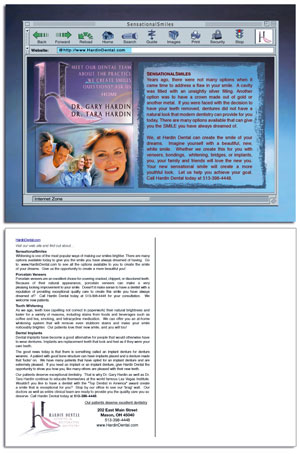 Web Site postcards
provide another level of engagement. By presenting the Web Site
as the overall theme of each card, you offer patients
a conduit to efficiently "window shop" your entire value
and expertise. Instead of sending a multi-themed brochure type
mailer, with
various offers that diminish your value and overwhelm the patient
- the Web Site postcard succinctly emphasizes a certain high-level
aspect of
your practice. It also encourages patients to seek more information
by visiting your Web Site.
Web Site postcards
provide another level of engagement. By presenting the Web Site
as the overall theme of each card, you offer patients
a conduit to efficiently "window shop" your entire value
and expertise. Instead of sending a multi-themed brochure type
mailer, with
various offers that diminish your value and overwhelm the patient
- the Web Site postcard succinctly emphasizes a certain high-level
aspect of
your practice. It also encourages patients to seek more information
by visiting your Web Site.  High-impact postcards
and email are powerful ways to interact with the patient, as they
are hard to avoid and are more individualized
than more
general formats
such as newspaper or radio. However, they are also more intrusive.
No one writes out a check to receive email or direct mail. Few
people have
a favorite
type
of direct mail or email ad. Yet, many pay for newspapers to be
delivered to their home and listen for hours to their favorite radio
station.
These are
effective
outlets to consistently communicate with the patients.
High-impact postcards
and email are powerful ways to interact with the patient, as they
are hard to avoid and are more individualized
than more
general formats
such as newspaper or radio. However, they are also more intrusive.
No one writes out a check to receive email or direct mail. Few
people have
a favorite
type
of direct mail or email ad. Yet, many pay for newspapers to be
delivered to their home and listen for hours to their favorite radio
station.
These are
effective
outlets to consistently communicate with the patients. Upscale marketing vehicles
are determined by the marketing environment in which you practice.
In a rural or sparsely populated
demographic,
it could be special publications produced by the local paper or in a larger
metro area it might
be a glossy city magazine, public, jazz or classical radio,
or
a
symphony or theatre
program. Cable television commercials on A&E, Discovery,
and HGTV (and to a lesser extent Lifetime) are another
possibility. The main thread of criteria
for upscale advertising is that it has a readership (viewers
or listeners) with a higher income demographic.
Upscale marketing vehicles
are determined by the marketing environment in which you practice.
In a rural or sparsely populated
demographic,
it could be special publications produced by the local paper or in a larger
metro area it might
be a glossy city magazine, public, jazz or classical radio,
or
a
symphony or theatre
program. Cable television commercials on A&E, Discovery,
and HGTV (and to a lesser extent Lifetime) are another
possibility. The main thread of criteria
for upscale advertising is that it has a readership (viewers
or listeners) with a higher income demographic. 
Copyright © 2003, Curtis Marketing Group. All Rights Reserved.